
Revolutionizing Preventative Health: The First Non-Invasive, Wrist-Worn Glucose Monitor.
A non-invasive, wrist-worn glucose monitor for the prediabetic market
We are raising a $10 million equity round to commercialize “The Caddy” for the rapidly growing prediabetic market.
US adults with prediabetes
bench agreement vs. glucometer*
Class II OTC pathway
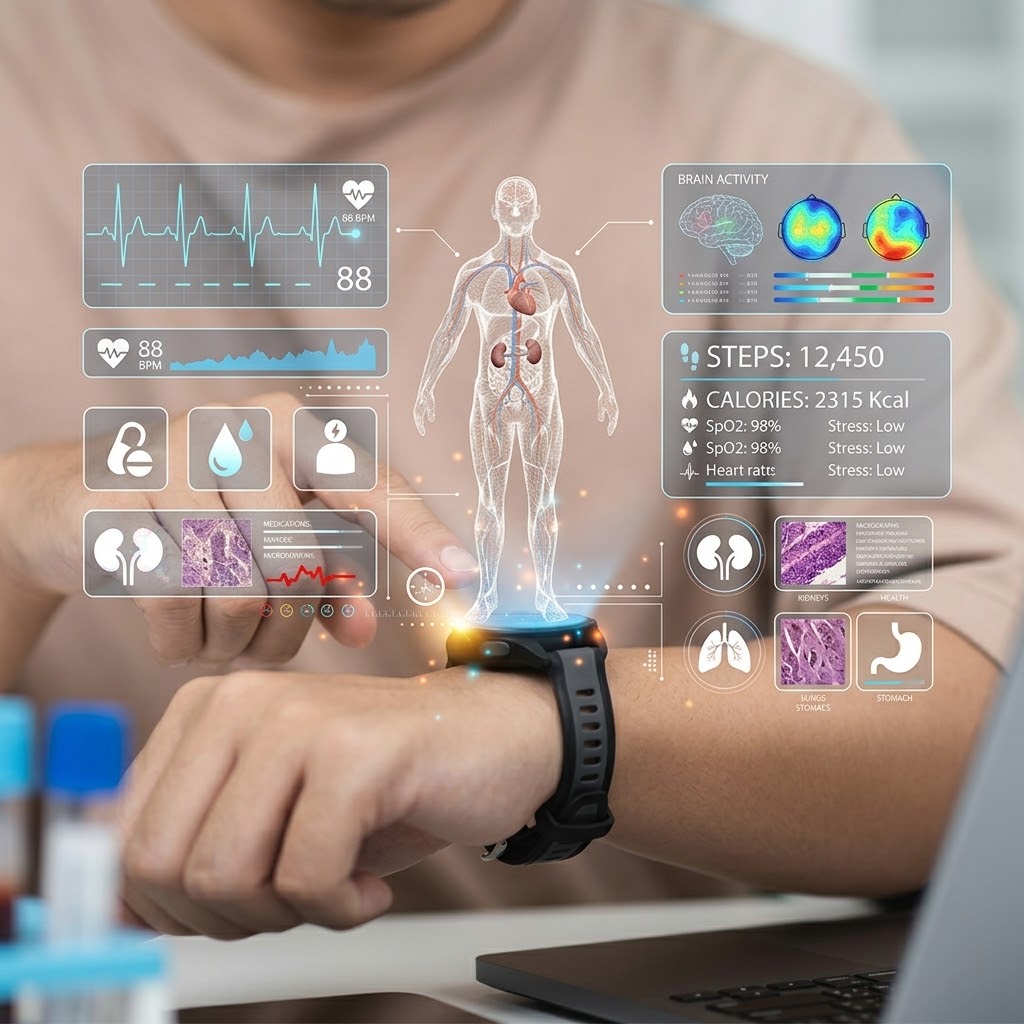
- Non-invasive bioimpedance sensing
- FDA 510(k) · Class II OTC pathway
- ISO 13485 quality system
- USPTO & PCT patent applications filed
- Apple & Google health app integration
- Launch: US · Canada · Mexico · Brazil · EU
- $10M Reg D private placement
- Non-invasive bioimpedance sensing
- FDA 510(k) · Class II OTC pathway
- ISO 13485 quality system
- USPTO & PCT patent applications filed
- Apple & Google health app integration
- Launch: US · Canada · Mexico · Brazil · EU
- $10M Reg D private placement
A Large, Under-Served Prevention Market
The current monitoring technology is built primarily for diagnosed patients, leaving a massive gap in preventative care.
Adults worldwide at high risk of type 2 diabetes.
US adults with prediabetes; 8 in 10 do not know it.
Global health spending on diabetes in 2024.
adults with diabetes in 2024, rising to 853M by 2050
Global burden
Beyond 589M adults with diabetes, 635M have impaired glucose tolerance and 488M have impaired fasting glucose, per the IDF Diabetes Atlas (11th ed., 2025).
United States
The CDC estimates 115.2M adults (more than 2 in 5) have prediabetes and 40.1M have diabetes. Lifestyle change can cut progression risk by about half.
A Gap in Care and in Technology

Care-model gap
Monitoring technology and reimbursement are built for diagnosed patients. Prediabetes is typically managed with brief counseling and episodic lab tests, while value-based payers and employers increasingly reward prevention.
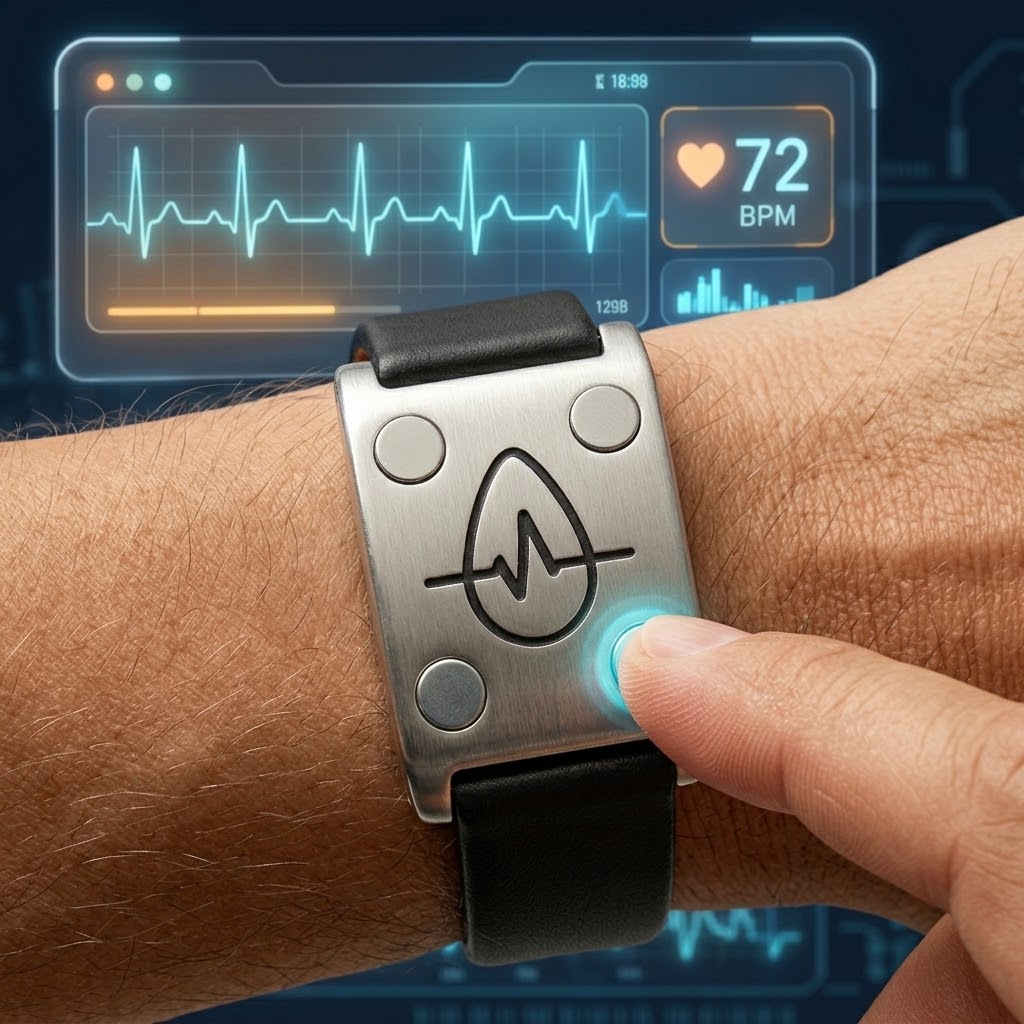
Consumer and OTC shift
The FDA cleared the first OTC continuous glucose monitors in 2024 (Dexcom Stelo, Abbott Lingo) for adults not on insulin and for general wellness, sold without a prescription at roughly $90 to $100 per month. Analysts frame the addressable base at about 96M US prediabetics.
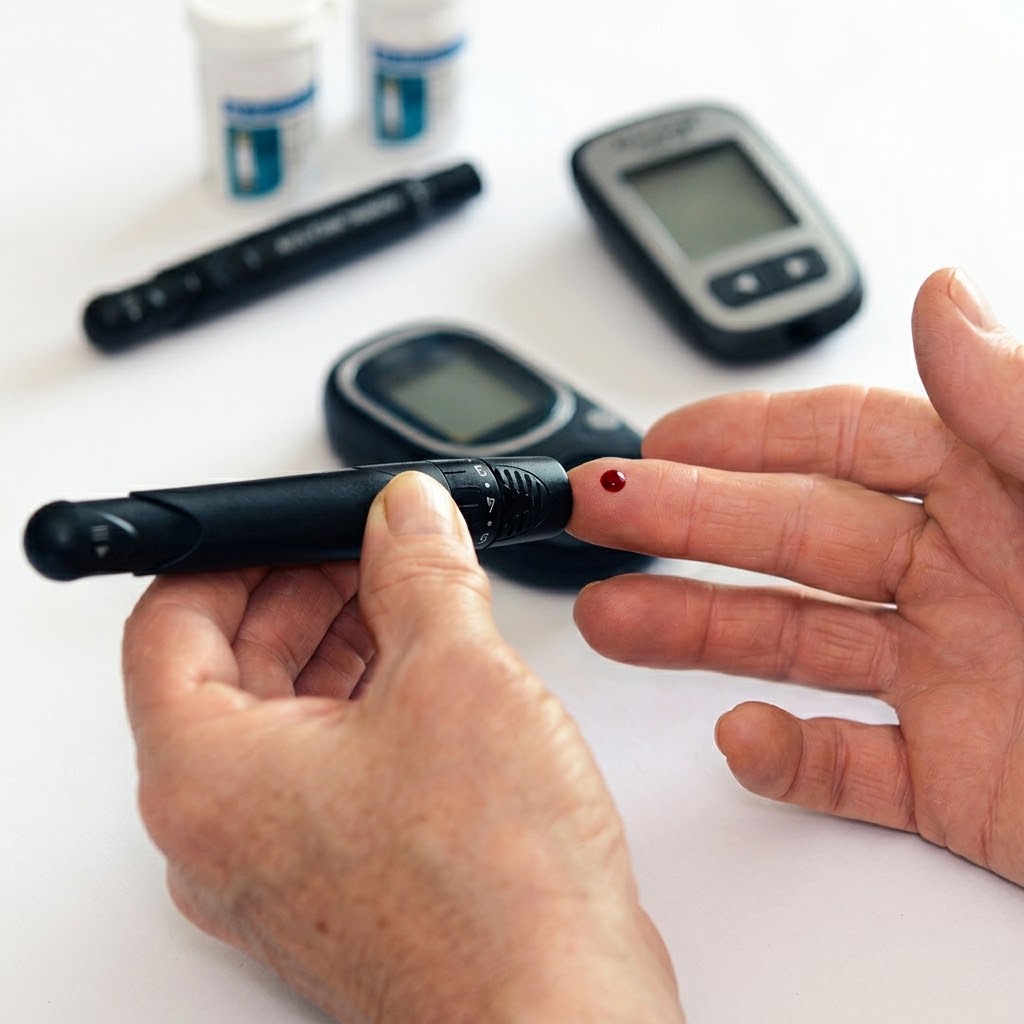
Unmet need and bar to entry
Cleared CGMs penetrate the skin, and most need sensor replacement every 10 to 15 days. In February 2024 the FDA warned that no smartwatch or smart ring measuring glucose without piercing the skin is authorized, and 2026 sources report none has been cleared since. A cleared non-invasive device would be first in category, and the accuracy and evidence bar is high.
Sources: IDF Diabetes Atlas, 11th ed. (2025); CDC; FDA.
Introducing The Caddy:
Wrist-Worn and Non-Invasive
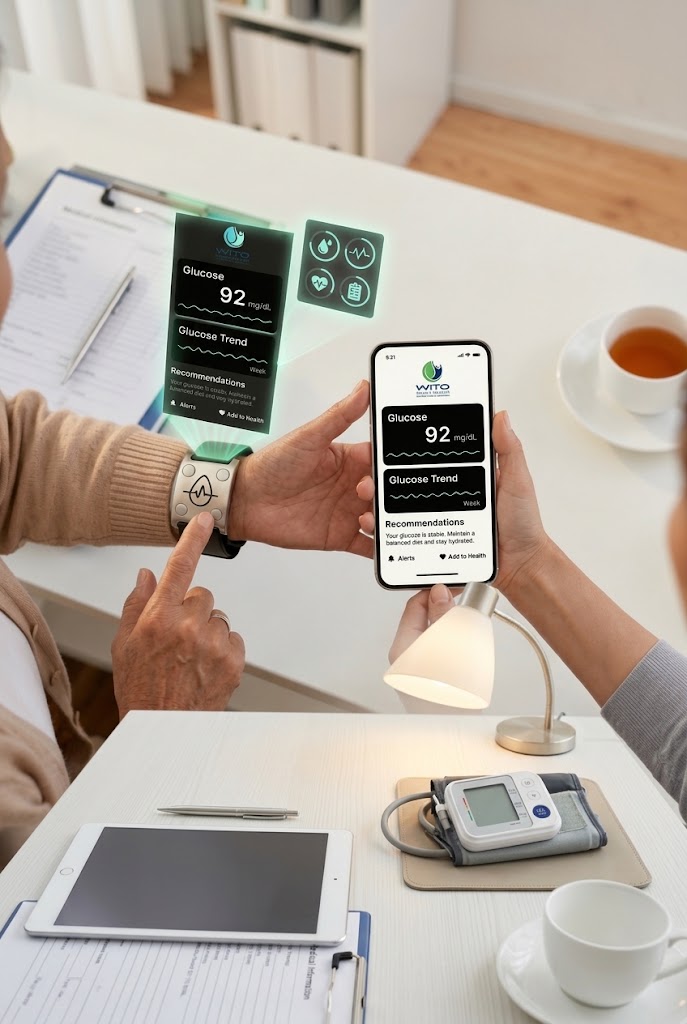
The FDA recently cleared the first OTC continuous glucose monitors, but they still penetrate the skin and require frequent replacement. The Caddy is entirely non-invasive, requiring no skin penetration.
Form Factor
A compact 1 × 1 × 0.5 inch module that clips to any standard ¾ inch watch band.
Sensing
Advanced bioimpedance sensor module coupled with cloud machine learning that converts readings into a glucose score.
Measurement
On-demand readings via a simple two-finger tap on top of the module.
Technical Specifications
1 × 1 × 0.5 inch module for a standard ¾ inch watch band
On demand: tap two fingers on the top
Bioimpedance sensor module
Cloud machine learning converts bioimpedance data to a glucose score
Bluetooth to a smartphone app
Rechargeable battery
Apple and Google health apps
Non-invasive
Bioimpedance, no skin penetration
Clip-on
Clips to any watch band
Over the counter
Class II device via FDA 510(k)
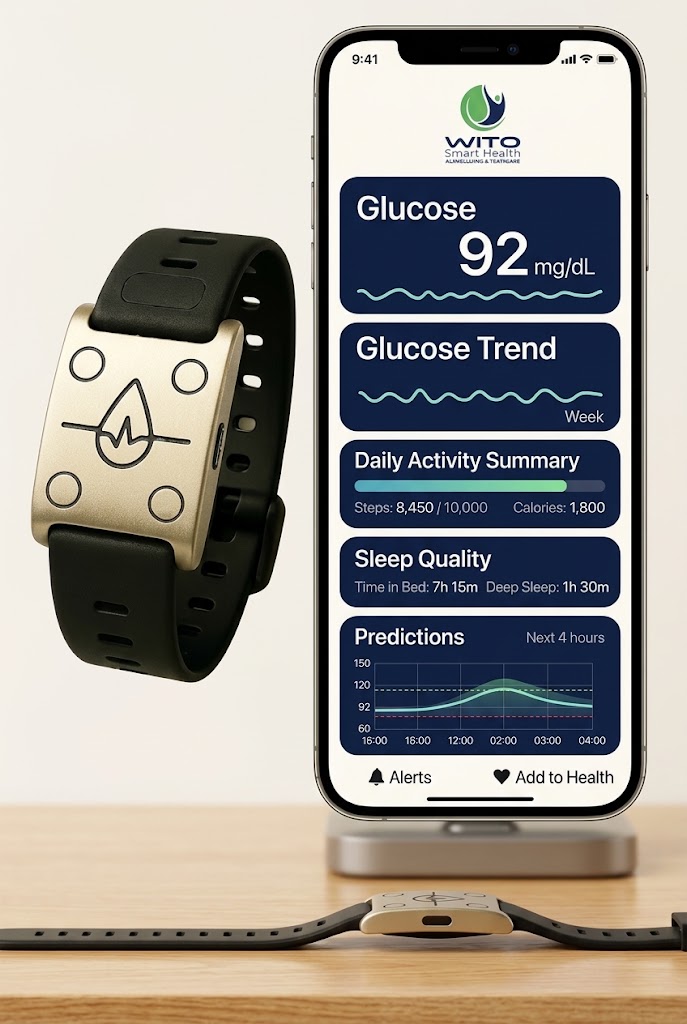
Later biomarkers (hydration, cortisol, cholesterol) would need new algorithms. Product images are illustrative company concepts; the final design may differ.
Scalable Direct-to-Consumer Subscription Model
We are deploying a web-first DTC strategy targeting at-risk adults, with primary care physicians serving as a referral channel.
Device Plus Monthly Subscription
Estimated hardware cost per unit
Forecasted retail device price
Monthly subscription in the model, rising to $24 from 2029
Hardware: Estimated cost per unit of ~$55, with a forecasted retail price of $60.
Sales approach
Direct to consumer, web first, through a BigCommerce or Shopify storefront with Paywhirl billing. Channel partners come later.
Pricing still being tested
The business plan tests $0 for the device plus $39.95 per month, versus about $69.99 plus $19.99 per month.
Customer, Go-to-Market and Manufacturing
At-risk adults first
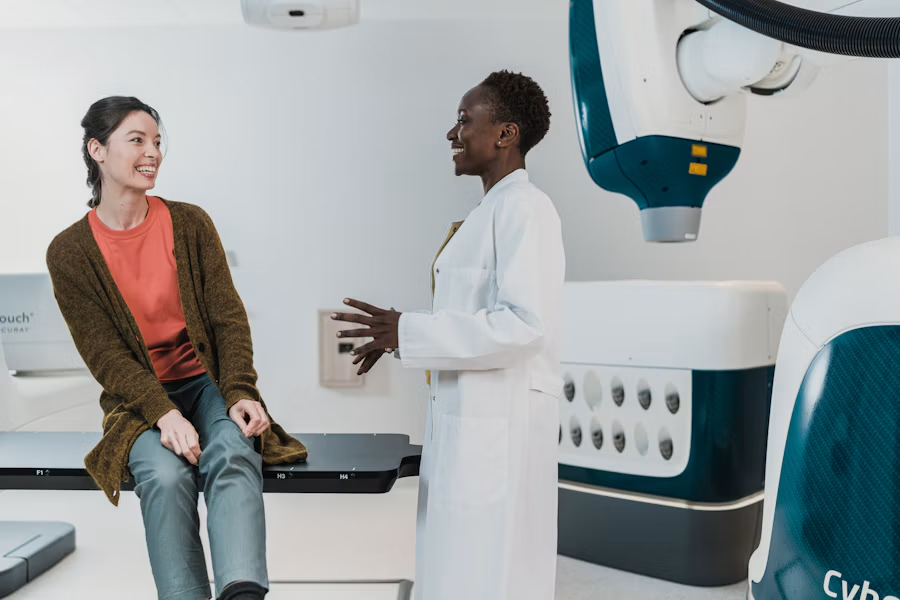
Pre-diabetic and at-risk adults first, then families and pediatrics. Primary-care physicians serve as a credibility and referral channel, not a prescribing gate.
Education-led launch
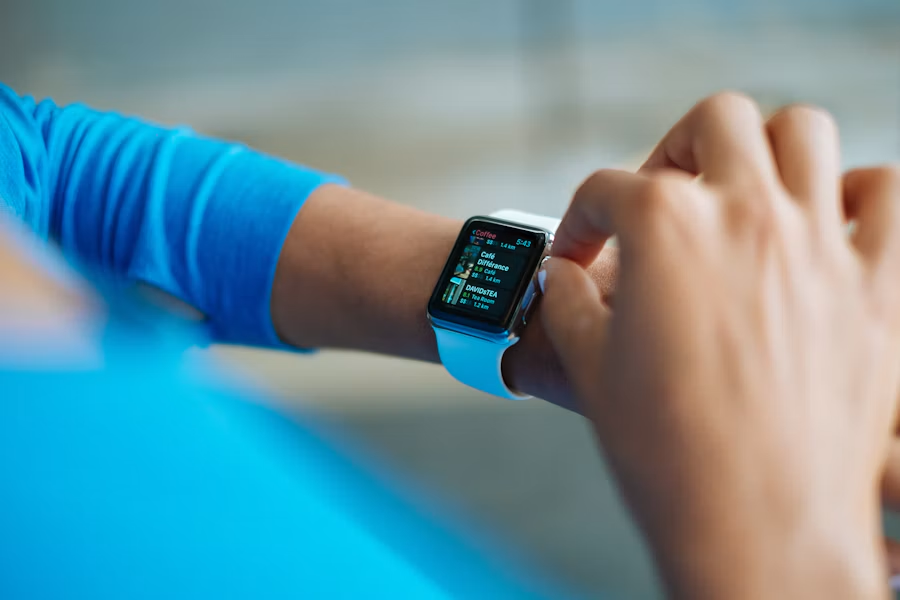
Digital and education-led marketing, KOL and healthcare-professional outreach, and a pre-launch waitlist. Launch in the US, Canada, Mexico and Brazil on clearance; the EU follows on CE mark.

Contract manufacturing
OES (ISO 13485-certified) is the preferred candidate and Andrews-Cooper leads engineering. No manufacturing agreement is executed.
Clear FDA 510(k) Pathway and Proven Progress
Milestones Reached to Date
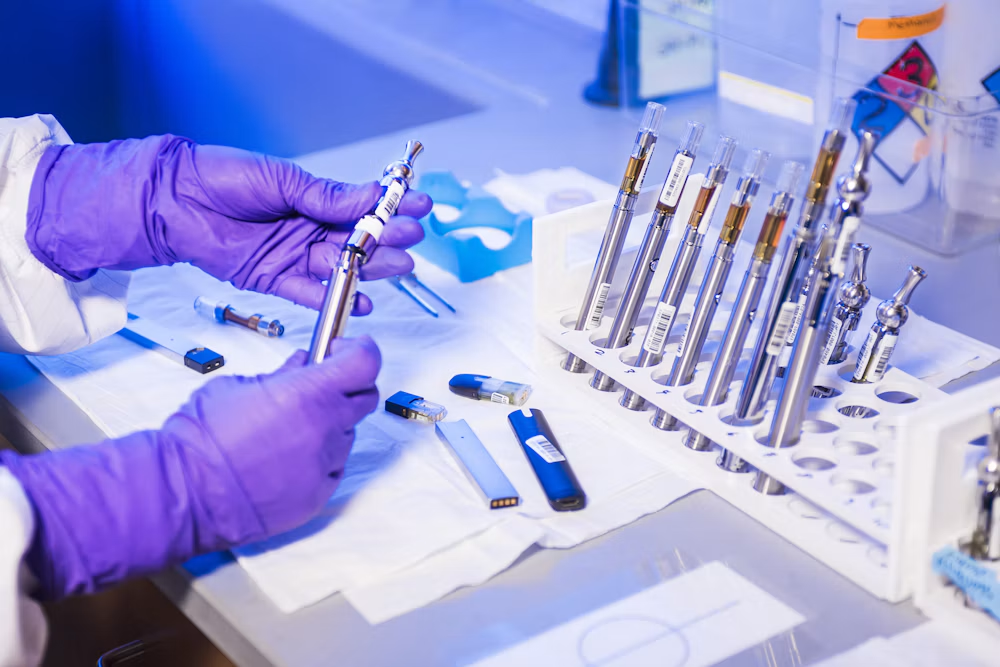
Proof-of-concept prototype
Early bench-tested prototypes report glucose scores within about 1% of a standard glucometer.
Patent applications filed
USPTO non-provisional and PCT patent applications have been filed: a USPTO non-provisional application (August 2024, continuation of a PCT) and a PCT filing.
Development and manufacturing
Andrews-Cooper engaged for engineering and MVP prototypes. OES (ISO 13485) is the preferred contract manufacturer.
Regulatory readiness
Drafted an FDA pre-submission package, clinical protocol package, CRO request for proposal and 510(k) substantial-equivalence memo (v1.2).
Regulatory Timeline
We are targeting a Class II, over-the-counter clearance via the FDA 510(k) pathway. We plan to submit the 510(k) 8 months after our first two tranches close, expecting clearance 4 months later.
First two tranches close
Starting point for the regulatory timeline
Submit 510(k)
Planned 8 months after the first two tranches close
FDA clearance
Expected 4 months after submission
International
CE/MDSAP, Health Canada, COFEPRIS, ANVISA
Launch order: US → Canada → Mexico → Brazil → EU
Classification: Class II, over the counter, under an ISO 13485 quality system. Launch order: US, Canada, Mexico, Brazil, then the EU.
Management Team
Decades of medical-device operating, financial and clinical leadership.
Glenn S. Foley
40+ years in medical devices, previously CEO of Precision Vascular Systems (acquired by Boston Scientific).
- 40+ years in medical devices; B.A. Biology, East Stroudsburg University
- Founder and CEO, Dome Medical Technologies (2018–21); LapDome device, ISO 13485 via BSI
- Chairman and CEO, Precision Vascular Systems (2001–04); FDA clearance, CE mark, acquired by Boston Scientific
- Global VP Sales, Medtronic Vascular and Arterial Vascular Engineering (1996–2001); $625M revenue under management in 1999
James (Jim) Turner
Medical device and SaaS finance executive; former VP Finance at Mobile Labs.
- Finance and operations executive; medical-device and SaaS experience
- Director of Finance and Business Operations, Core Access Surgical Technologies
- VP Finance, Mobile Labs (2014–20); sold to a strategic buyer
- Earlier roles at MCI/WorldCom/Verizon Business and Ernst & Young
- Master of Accountancy and BBA, University of Georgia; passed the CPA exam
Arthur Malvett
Former COO of Dome Medical Technologies and Life Care Medical Devices.
- Leads the Brazil and Mexico launch; administrative advisor to the CEO
- COO and Managing Director, Dome Medical Technologies (2013–21)
- COO, Life Care Medical Devices (2008–13); led its 2012 reverse merger to the OTC market
- Earlier VP, Midland Bank Trade Services; fluent in English, Spanish and Portuguese; BBA, Pace University
Eliot Jekowsky, M.D., Ph.D., M.B.A.
Board-certified physician and former Medical Director at Blue Cross Blue Shield of Massachusetts.
- Medical Director roles, Blue Cross Blue Shield of Massachusetts (2002–18); medical policy and Medicare Advantage
- Consultant since 2016 on clinical evidence and payer reimbursement for device and health-tech companies
- Board-certified in internal medicine since 1985; licensed in Massachusetts since 1983
- Ph.D. Biochemistry (MIT), M.D. (University of Miami), MBA (Northeastern)
Specific and General Risks
Investors should consider the following risks carefully. Private securities are speculative, illiquid, and carry a high degree of risk, including the loss of the entire investment.
Technology and clinical
Only a bench test of an early prototype exists (company-reported ~1% agreement with a glucometer); there is no clinical data. Non-invasive glucose sensing has a long record of failed attempts, and an accuracy claim this tight should be treated skeptically until independently reproduced.
Regulatory pathway and timing
No non-invasive glucose device is cleared, and the FDA’s 2024 safety communication signals a high bar. The plan cites a blood-pressure app as predicate, which may not support substantial equivalence; a De Novo or PMA route would add time and cost.
Execution and margins
Development depends on contractors with no executed manufacturing agreement and no in-house engineering team.
Commercial
Pricing is unresolved ($9, $22, $39.95 and $19.99 per month all appear in company materials). Dexcom and Abbott already sell OTC CGMs at roughly $90 to $100 per month with strong distribution, and large wearable makers are pursuing the same goal.
Intellectual property
Only pending applications exist; none has issued. A 2014 priority date may limit remaining term after launch (counsel to confirm).
Management and governance
Key-person concentration: three management-linked entities hold ~59% fully diluted. The CFO’s entity is lender, warrant holder and a ~19% shareholder, and the loan was signed for the company by Mr. Malvett.
Market and regulatory
- Adversely impacted by weakness in the markets we serve
- New legislation or regulatory laws may affect performance
Business and operations
- May be unable to successfully execute and manage growth strategy
- Success depends on ability to hire, train and retain key personnel
Our industry
- Highly competitive industries; competitors may have greater resources
- Unfavorable conditions could impact business, results and cash flows
Funding and debt markets
- Dependent on secured/unsecured funding; replacement financing may be unavailable
- Economic and legal conditions could adversely affect transactions and cash flows
- Earnings and reputation may be affected if risk is not properly managed
Proposed financing
- No assurance additional capital will be obtained as needed
- No guarantee of success; potential for loss of entire investment
- Projections may not accurately reflect future profitability
- No current market for these securities; resale may be limited
The Offering: $10M Equity Raise
We are seeking institutional and accredited investors for a Reg D private placement. Target investors include Family Offices, PE, VC, and strategic partners.
To develop the Caddy, a non-invasive, wrist-worn glucose monitor for pre-diabetics
Reg D private placement
PE, VC & strategic investors
Non-invasive, wrist-worn glucose monitor
8 months after the first two tranches close
Fully allocated to the uses below
Request Investor Access
Schedule a briefing or request the data room. A member of the deal team at Castle Placement, our placement agent, will follow up.
- Reg D private placement
- Institutional & accredited investors only
Sources and Uses of Funds
Equity raise, fully allocated
- Staffing and compensation
- Business development
- General and administration
- Product development
- Transaction expenses and fees
Source: $10M equity raise, fully allocated to the uses above. These sources and uses represent current objectives and may change.
Castle Placement, LLC
Member FINRA, SIPC · The Premier Private Capital Investment Bank®*
Offices: New York · Atlanta · Austin · Boston · Columbus · Denver · Detroit · Houston · Los Angeles · Miami · Palm Desert · Salt Lake City · St. Louis
* Registered trademark and subjective slogan of Castle Placement®